
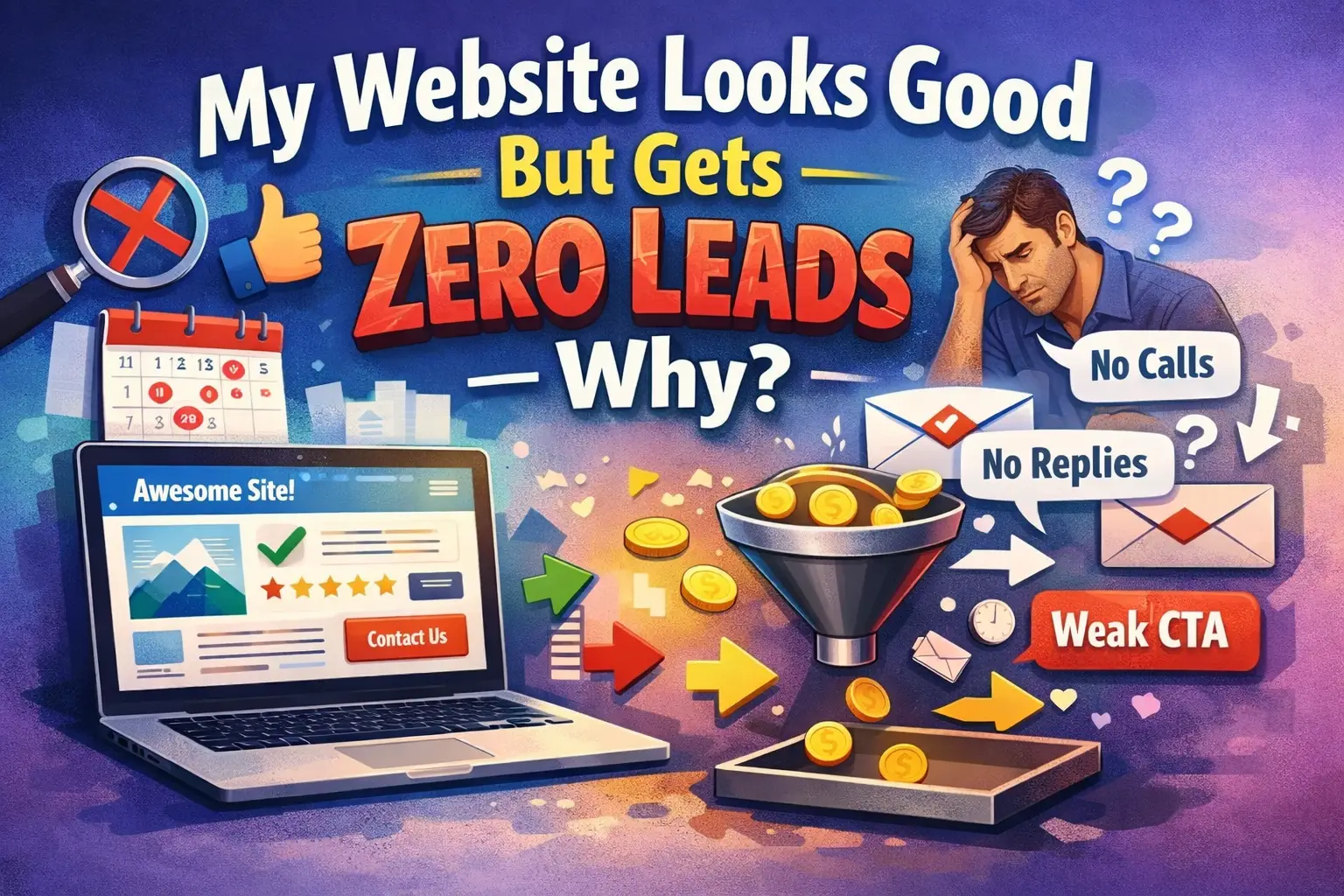
You spent months — maybe years — building your website. The colors are on-brand, the fonts are clean, the layout is modern. Your friends say it looks “really professional.” Your designer did a great job.
Yet your contact form inbox is empty. Your phone isn’t ringing. And your Google Analytics bounce rate makes your stomach drop every time you check it.
You’re not imagining the problem. And you’re definitely not alone.
This is one of the most common and painful situations in digital marketing — a beautiful website that generates absolutely zero business. The good news is that it’s almost always fixable once you understand why it’s really happening.
Here’s the truth nobody tells you: design and conversion are two completely different things. A website can win awards and still fail at its only real job — turning visitors into leads.
Let’s break down exactly why that happens, and what you can do to fix it.
The Gap Between a Good-Looking Website and a Lead-Generating One
Most business owners make the same honest mistake. They invest heavily in making their website look credible — and they should. A professional design matters. It builds first impressions. It signals that you’re a legitimate business worth taking seriously.
But here’s where things go wrong: once the design is done, most people assume the work is finished. They launch the site, share it on social media, maybe run a few ads, and then wait for the leads to come in. They don’t.
The reason is simple. Design is about appearance. Conversion is about behavior. These are two entirely different disciplines, and most web designers are trained in one but not the other. Your designer’s job was to make your website look good — and they likely succeeded. But nobody told your website what to do after someone lands on it.
A lead-generating website is not just a good-looking website. It is a carefully engineered sequence of decisions — every headline, every button, every image, every line of copy — all working together to guide a visitor from curiosity to contact. When that engineering is missing, even the most beautiful website sits silent.
The gap between “looks great” and “generates leads” is not a design gap. It is a strategy gap. And once you understand that, everything else starts to make sense.
1. You Have No Clear Call-to-Action
This is the number one silent killer of leads. Design without direction is just decoration.
If a visitor lands on your homepage and can’t immediately tell what you want them to do next, they’ll do nothing. And “nothing” is exactly what you’re getting. Vague buttons like “Learn More” or a contact form buried three scrolls down don’t work. Your call-to-action needs to be unmissable, emotionally compelling, and tied to a specific outcome your visitor actually wants.
The fix is simpler than you think. Put one primary CTA above the fold on every key page. Use language that describes the result, not the action. “Get Your Free Audit,” “Book a 15-Minute Strategy Call,” or “Download the Free Guide” will always outperform “Submit” or “Contact Us.” People don’t want to contact you — they want the outcome you’re offering.
2. Your Value Proposition Is Invisible
Within five seconds of landing on your website, a visitor should be able to answer three questions without scrolling: What do you do? Who do you do it for? Why should they choose you over anyone else?
Most websites fail this test completely. They bury the most important information below the fold, wrap it in corporate jargon, or assume visitors already know what the business does. They don’t. And they won’t scroll down to find out.
Your headline is the most important piece of copy on your entire website. “We help SaaS companies reduce churn by 30% in 90 days” will generate dramatically more leads than “Innovative Solutions for Modern Businesses.” One speaks directly to a specific problem. The other says nothing to anyone.
Be specific. Be direct. Make the benefit impossible to miss.
3. You’re Attracting the Wrong Traffic — or No Traffic at All
Here’s a possibility that’s hard to hear: sometimes the website isn’t the problem. The traffic is.
If you’re ranking for keywords your ideal buyer never searches, or running ads to cold audiences with no purchase intent, no amount of design polish or conversion optimization will save you. Traffic quality matters far more than traffic volume. A hundred highly qualified visitors will always outperform ten thousand people who were never going to buy anyway.
Audit your top traffic sources with an honest eye. Ask yourself: are these visitors actually my ideal customers? Look at the keywords bringing people to your site. Intent-based keywords like “hire a freelance copywriter in Mumbai” will convert at a completely different rate than informational keywords like “what is copywriting.” One is from someone looking for a solution. The other is from someone doing research.
If your traffic is genuinely qualified and still not converting, then you have a conversion problem. If it’s not qualified, fix the traffic first.
4. Your Website Has No Trust Signals
Your visitors are strangers. They don’t know you, they’ve never worked with you, and they have every reason in the world to be skeptical. If your website has no testimonials, no case studies, no client logos, no results, and no social proof of any kind — why would anyone hand over their contact information?
Trust must be earned before a lead can be captured. And trust is built through evidence, not claims.
The difference is enormous. A generic claim like “We deliver results for our clients” does nothing. A specific testimonial like “Working with this team doubled our inbound leads in 60 days — we went from 8 to 19 qualified calls per week” is powerful because it’s real, it’s specific, and it shows exactly what a new client can expect.
Add at least three strong, outcome-focused testimonials near your primary CTA. If you have impressive client logos, show them. If you have data, use it. Want to see how powerful real case studies are? Browse Kmarks’ client case studies — they don’t just claim results, they document them in full detail.
5. Your Lead Capture Form Asks for Too Much
Every additional field in a contact form reduces the likelihood that someone will complete it. Research consistently shows that reducing form fields increases conversion rates — sometimes dramatically.
Asking for a visitor’s name, company, phone number, email, budget, timeline, and project description on their very first interaction with your business is a conversion killer. You’re asking for a high level of commitment before you’ve given them any value in return. The relationship hasn’t earned that level of trust yet.
Start with the minimum viable ask. In most cases, a name and email address is enough to begin the conversation. You can qualify the lead further on a discovery call, or through a well-designed email sequence. The goal of your form isn’t to gather data — it’s to start a relationship.
6. Your Website Was Designed to Be Admired, Not to Convert
This one stings, but it’s necessary to say. Beautiful and effective are not the same thing, and they are often in direct conflict.
Full-screen hero videos that take ten seconds to load, complex animations that bury your CTA, trendy layouts that prioritize visual impact over clarity — these win design awards and sabotage conversion funnels. Many designers are optimizing for aesthetics. Your website needs to be optimized for decisions.
Go through your website page by page and ask yourself a single brutal question about every element: does this make it easier or harder for my visitor to take the next step? Anything that makes the answer “harder” needs to go. Simplify aggressively. The best-converting websites in the world are often shockingly simple.
Your website’s job is not to impress. Its job is to convert. If you’re unsure whether your site is currently doing that job, Kmarks Web Solutions’ services are designed to close exactly that gap.
7. Your Copy Talks About You Instead of Your Visitor
Read your homepage copy right now and count how many times you use “we,” “our,” and “us” versus “you” and “your.” In most cases, the ratio is embarrassingly company-centric.
Your visitors don’t come to your website because they’re interested in your company. They come because they have a problem, a goal, or a question, and they want to know if you can help them. They are thinking entirely about themselves — and they should be. It’s your job to meet them where they are.
Reframe every feature as a direct benefit for your visitor. “We have 12 years of industry experience” means nothing to someone in pain. “You get 12 years of proven strategies working specifically for your business” speaks directly to what they care about. Same information, completely different impact.
Write for your visitor’s problem, not your company’s story.
The Hardest Truth About Websites and Lead Generation
Most business owners optimize for the website they wish they had, not the customer they’re actually trying to serve.
Real conversion optimization starts with ruthless empathy. It means deeply understanding what your visitor is thinking, feeling, and fearing the moment they land on your page. It means making it effortless for them to take the next step. And it means measuring everything, testing constantly, and being willing to change what isn’t working — even if it looks great.
Your website looking good is table stakes in 2025. Every competitor has a polished site. The businesses winning online aren’t winning because of better design. They’re winning because of better clarity, stronger trust, and a relentless focus on removing every possible obstacle between “visitor” and “lead.”
Stop treating your website as a digital portfolio. Start treating it as your best salesperson — one who works 24 hours a day, seven days a week, never takes a day off, and has exactly one job: to turn a stranger into a conversation.
If you’re not sure where to start — or you’ve tried fixing things on your own and still aren’t seeing results — that’s exactly what Kmarks Web Solutions is here for. We help businesses diagnose why their website isn’t converting and build a clear, strategic path to consistent lead generation. Whether it’s a full website overhaul, a targeted SEO strategy, that keeps everything running at peak performance, we’ve got you covered.
Reach out to the Kmarks Web Solutions team today. Call us at (334) 472-0686 or drop us a line at support@kmarks-solutions.com. The leads you’re missing are closer than you think — let’s go get them.
