
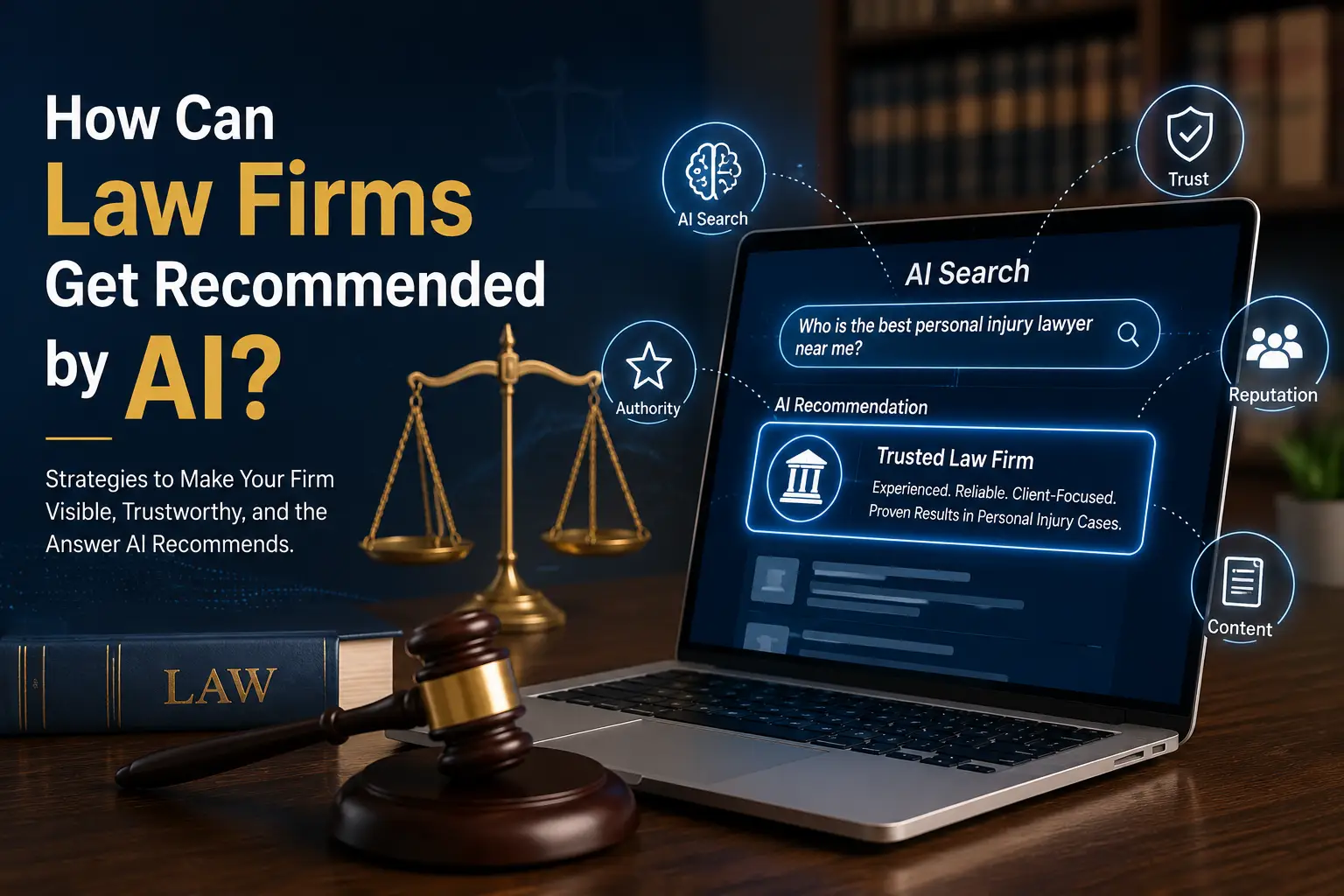
For years, law firms competed to rank on Google’s first page. Today, the way potential clients search for legal help is changing.
Instead of typing short keywords like “personal injury lawyer near me,” people are now asking AI platforms complete questions:
- Who is the best divorce lawyer in Birmingham?
- Which law firms have experience with truck accident cases?
- Can you recommend a law firm that offers free consultations?
- What attorney has a trustworthy website and good online reviews?
AI search tools like ChatGPT, Google AI Overviews, Gemini, Perplexity, and Claude are becoming part of the client discovery journey. If your law firm isn’t visible to AI systems, you could be missing opportunities to attract new clients.
The good news is that law firms can position themselves to become easier for AI to understand, trust, and recommend.
Why AI Recommendations Matter for Law Firms
Legal services are high-trust purchases.
Unlike buying a product online, clients often spend days researching attorneys before making contact. AI tools help simplify that process by analyzing information from multiple sources and surfacing firms that appear authoritative, credible, and helpful.
AI systems evaluate signals such as:
- Website content quality
- Practice area expertise
- Online authority
- User experience
- Business consistency across platforms
- Reviews and reputation
- Content that directly answers user questions
Law firms that build a strong digital presence have a much better chance of being surfaced in AI-generated answers. AI platforms increasingly prioritize trustworthy, structured, and user-focused information when generating responses.
1. Build a Website AI Can Easily Understand
Many law firm websites still act like online brochures.
They contain a homepage, a contact page, and a few generic practice area descriptions.
That’s no longer enough.
AI systems prefer websites with clear organization and detailed information.
Your website should have dedicated pages for:
- Every practice area
- Attorney profiles
- Frequently asked questions
- Client resources
- Location pages
- Case results (where ethically permitted)
- Educational blog content
A properly structured website helps both users and AI systems quickly understand your expertise.
If you’re planning to redesign your website, investing in specialized law firm design can significantly improve visibility and client trust. Kmarks Solutions offers dedicated services for attorneys through their Law Firm Web Design Agency page.
2. Answer Questions Your Clients Are Already Asking
AI search engines thrive on question-and-answer content.
Law firms that publish educational content have an advantage because AI can extract and summarize those answers.
Examples include:
- What should I do after a car accident?
- How long does a divorce process take?
- What compensation can I recover after an injury?
- How much does hiring a lawyer cost?
Instead of creating content around isolated keywords, build pages around real client concerns.
Think about the conversations you have every day during consultations.
Those questions are content opportunities.
The more helpful your content becomes, the more likely AI systems are to reference your expertise.
3. Demonstrate Expertise in Specific Practice Areas
Generalized messaging weakens authority.
A website that says:
“We handle all legal matters.”
is less helpful than one that clearly explains:
- Personal injury law
- Family law
- Criminal defense
- Estate planning
- Employment law
AI systems look for topical authority.
The more comprehensive your information is within a specific area, the stronger your credibility becomes.
Instead of trying to rank for everything, dominate your niche.
For example, if personal injury is your focus, create content covering:
- Car accidents
- Truck accidents
- Motorcycle accidents
- Wrongful death claims
- Slip and fall cases
- Insurance claim disputes
This builds a strong knowledge ecosystem around your practice.
4. Improve Trust Signals Across Your Website
Trust is one of the biggest factors influencing AI recommendations.
Potential clients want confidence before contacting an attorney.
Your website should clearly display:
- Attorney biographies
- Years of experience
- Bar memberships
- Certifications
- Awards
- Client testimonials
- Contact information
- Office locations
Professional design also matters.
Outdated websites can unintentionally reduce credibility.
Modern legal websites prioritize simplicity, readability, and intuitive navigation because stressed clients need answers quickly. Mobile responsiveness and clear calls to action also improve engagement.
5. Showcase Real Examples of Your Work
AI values evidence.
One effective way to build trust is by highlighting previous projects, case studies, or examples of successful website implementations.
If you’re improving your firm’s digital presence, showcasing proven legal website examples can strengthen authority and inspire ideas for your own strategy.
You can review Kmarks Solutions’ Law Firm Portfolio to see examples of websites built specifically for legal professionals.
This type of content demonstrates experience instead of simply claiming expertise.
6. Prioritize User Experience
Law firms often underestimate how much user experience impacts visibility.
A confusing website causes visitors to leave quickly.
Strong user experience includes:
- Fast loading speeds
- Mobile optimization
- Clear navigation
- Accessible contact forms
- Simple layouts
- Easy-to-read typography
Potential clients often visit legal websites during stressful situations.
If they struggle to find information, they will likely move on to another firm.
AI systems also reward websites that create positive user experiences because they indicate usefulness and credibility.
In fact, many firms overlook simple website improvements that can significantly impact trust and conversions. Understanding the Top 10 Features Every Law Firm Website Should Have can help you identify the essential elements that both potential clients and AI search platforms expect from a modern legal website.
7. Build a Strong Content Ecosystem
One blog post won’t make your firm visible to AI.
Consistency matters.
Create interconnected content around your expertise.
For example:
Main Topic: Personal Injury Law
Supporting topics:
- What to do after a car accident
- How insurance companies evaluate claims
- Average timelines for injury settlements
- Common mistakes accident victims make
- How comparative negligence works
Link these pages together.
This creates topical authority and helps AI understand the depth of your expertise.
8. Think Beyond Traditional SEO
Traditional SEO is still important, but search behavior is evolving.
People are no longer searching with simple keywords.
They’re having conversations.
The goal is no longer:
“Rank #1 for lawyer near me.”
The new goal is:
“Become the most trusted source AI can confidently recommend.”
That requires a combination of:
- Strong website architecture
- Helpful content
- Expertise
- Trust signals
- Consistent branding
Law firms that adapt early will have a significant advantage as AI search adoption continues to grow.
Final Thoughts
The legal industry is entering a new era of digital visibility.
Clients are increasingly asking AI systems for recommendations before visiting individual websites.
Law firms that build authoritative, client-focused, and trustworthy digital experiences will be better positioned to appear in those conversations.
Instead of asking, “How do we rank higher on Google?”
The better question today is:
“How do we become the law firm AI trusts enough to recommend?”
The answer is simple: create a website and content ecosystem that genuinely helps people solve their legal problems.
At Kmarks Solutions, we help law firms build AI-friendly websites, strengthen their online authority, and create digital experiences that attract both potential clients and modern AI search platforms.
When you become the most helpful and trusted source online, both people and AI begin to notice.
